
America Year 250: What If We Stopped Waiting?
For decades, we have placed our trust in elected officials to better our lives. We voted, then we waited. We waited for wages that kept pace with the cost of living, for a healthcare system that didn’t feel like a trap, for schools that gave every child a real chance. We have been waiting a long time.
In the meantime, we were fed stories. Trickle-down economics, we were told, would lift us all. Immigrants, we were warned, were consuming our share. These stories served a purpose — not ours. They kept us divided, distracted, and easier to manage. We absorbed them, perhaps because the alternative was harder to face: that we had grown used to a life of struggle, had learned, quietly, to be helpless.
But something is shifting. Across the country, people are waking to the fact that we have more in common with our neighbors than with the oligarchs who profit from our division. The We in “We the People” is gaining weight again. Our power is becoming tangible — not as a slogan, but as a felt reality.
Which brings us to a question worth sitting with: Are we ready to stop being spectators?
* * *
A Different Way of Showing Up
America Year 250 — named for our country’s 250th anniversary, arriving now — is my invitation to renewal, and a different posture toward democracy itself. It is not a political party, a petition, or a march, though marches have their place. It’s my proposal that we begin a new civic journey with a single shift: from passive spectators during election cycles to active creators.
In the spectator model, elections are performances we watch. Candidates give stump speeches optimized for enthusiasm, not accountability. We respond to their personas, their energy, their party affiliation. Then we go home and wait again for someone else to shape our lives.
America Year 250 refuses that arrangement. It says: we are not here to be impressed. We are here to govern ourselves.
In practice, this means we come to elections already knowing what we want. We formulate it clearly — not as vague hopes, but as specific conditions we expect our lives to meet. We meet with candidates and conduct interviews, doing more than simply attending rallies organized by the political establishment. We ask candidates about their funding sources, their past performance, their commitments, their qualifications to enact what we want. We make clear that our vote is not a gift; it is a contract, and we intend to hold them to it.
It means claiming what the Declaration of Independence calls our “unalienable rights” — not as rhetoric, but as a practical standard. These are rights inherent to us as human beings, not granted by government, and therefore not subject to being quietly taken away by it. We remind ourselves, and our candidates, of that distinction.
It means, above all, placing ourselves inside a structure of mutual responsibility — with our neighbors, our communities, our fellow citizens — rather than remaining outside it, alone, blindly trusting who we voted for, and waiting.
* * *
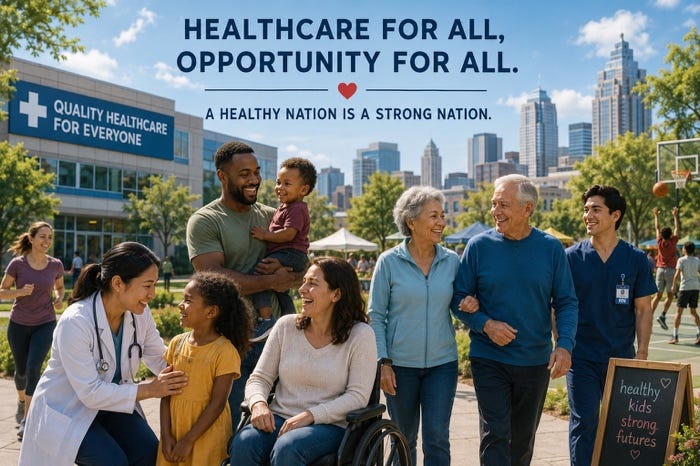
What This Looks Like: America Year 250 and Healthcare
Politicians can pack us and crack us — those are the technical terms for how congressional districts are drawn to dilute certain votes — but they cannot gerrymander away what we actually need. Healthcare is one of those needs. It doesn’t care which side of a district boundary you live on. It doesn’t ask your party affiliation before it fails you.
We have been asking for a better healthcare system for decades. Millions among us have no access at all. Millions more live in what we might call healthcare insecurity — one diagnosis away from financial ruin. And millions more are trapped in a system that is, by design, more profitable when it says no to us than when it says yes.
We have trusted our elected officials to fix this. They have not fixed it.
So what does America Year 250 look like here? It begins with us getting clear about what we want — not what we’ve been told is possible, not what lobbyists have pre-approved, but what we want:
A one-payer national system, where no one is turned away. Quality doctors, hospitals, clinics within reach of every town. No catastrophic bills, no fine print designed to trick us, no insurer profiting by denying our care. The same care team when we change jobs. Mental health treated as health. Problems caught early, before they become crises.
Then we do our research. The money exists in this country to build such a system — the numbers, examined honestly, make that clear. We commit to turning off the television ads paid for by insurance and pharmaceutical companies, whose interest is in our confusion and our resignation. We interview the candidates willing to fight for what we’ve decided we want, and we ask them hard questions. We vote for the ones with the best answers, and we watch them after they step into the job. This is not naive. This is what self-governance looks like when it’s taken seriously.
America Year 250 is a wager: that if we show up differently — more prepared, more demanding, more bound to one another — we will get something different in return. Not because the system will suddenly become generous, but because we will have stopped asking for generosity and started insisting on accountability.
Where we live should not determine how healthy we are. What we earn should not determine whether our lives are saved. None of us should be burdened by an inefficient healthcare system that generates insane amounts of profits. These are not radical propositions — they are the basic logic of a society that has decided its members matter. What happens to some of us happens to all of us. That is not a sentiment. It is a fact of shared life. Fundamental as well is our right to be free: freedom to know that a healthcare system will always be there to meet our needs; freedom to know that the system works in our best interest rather than to generate profit; freedom to know that we will receive excellent care without having to exhaust ourselves with self-advocacy in our moments of illness and needs. That is real freedom.
The question America Year 250 puts to each of us is simple: are we ready to act like we believe all this?
***
Addendum:
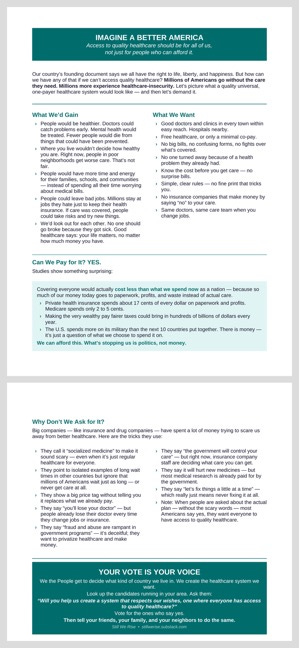
Below is a leaflet that can guide voters to stand up for their right to a quality national healthcare system. I am including a Google Doc version of this leaflet as well to allow you to print it out and distribute to your constituents, your neighbors.
________